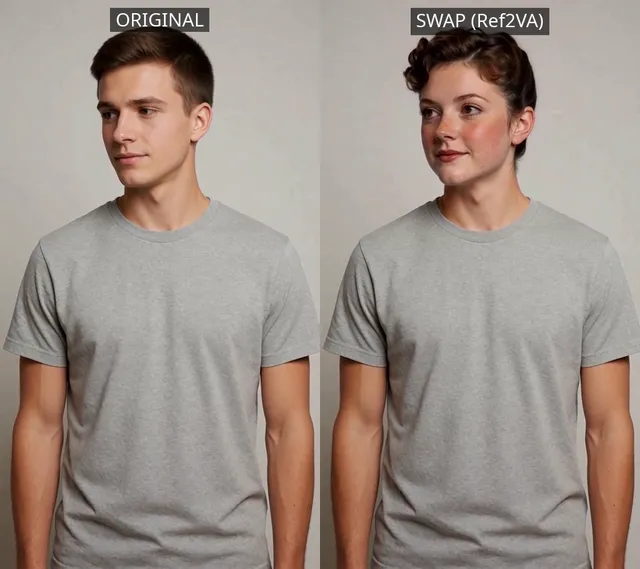
A small YouTube channel tested an 8-step acceleration LoRA Alibaba PAI released for MiniMax H3 — we confirmed it’s real: alibaba-pai/MiniMax-H3-Acc-LoRAs on HuggingFace, plus the custom node Jalen-Brunson/ComfyUI-MiniMax-H3-PDD-Acc you need to actually use it. The video’s central claim: the 4-step turbo LoRA we’ve used in earlier articles falls short in fast-action scenes.
We didn’t repeat its examples — we generated our own, with the same prompt and the same seed in every comparison, on our own RTX 3090. And the real finding isn’t the one we expected.
At a glance
| Aspect | Details |
|---|---|
| LoRA tested | MiniMax-H3-Ref2VA-Acc-8Step.safetensors (Alibaba PAI, official) vs minimax_h3_ref2v_turbo_4step_v0.1 (lightx2v, already used in earlier articles) |
| Main scene | Anime sword duel, 15.08s (360 frames), 832×480, seed 1007 |
| Confirmation scene | Short fight, 5.17s (124 frames), 832×480, seed 777 |
| Time (main scene) | 4-step: 229.5s — PDD Acc 8-step: 366.4s (+60%) |
| Time (confirmation scene) | 4-step: 79.9s — PDD Acc 8-step: 120.3s (+51%) — hybrid: 83.5s (warm cache, see limitations) |
| Real VRAM peak | 23.27GB (pure PDD Acc) — 23.53GB (hybrid) — both out of 24GB on RTX 3090 |
| Real finding | Not “4-step looks bad vs. PDD Acc looks good” — both look good frame by frame. It’s that 4-step holds an almost identical pose between second 7 and second 12 of the same clip; PDD Acc actually advances the choreography over that time |
| Installation | The LoRA goes in models/pdd_acc/ (not models/loras/), there are separate files for FL2VA and Ref2VA, and the custom node didn’t register until a full ComfyUI restart |
The finding, in video
Same prompt (anime sword duel, rain-soaked neon rooftop), same seed 1007, same duration: 4-step turbo (left) vs. 8-step PDD Acc (right).
At first glance, any single frame from either version looks good — clean anime-style animation, good silhouette separation, energy effects consistent with the prompt. The difference doesn’t jump out in an isolated frame. It jumps out when you compare the SAME moment in time across both videos:
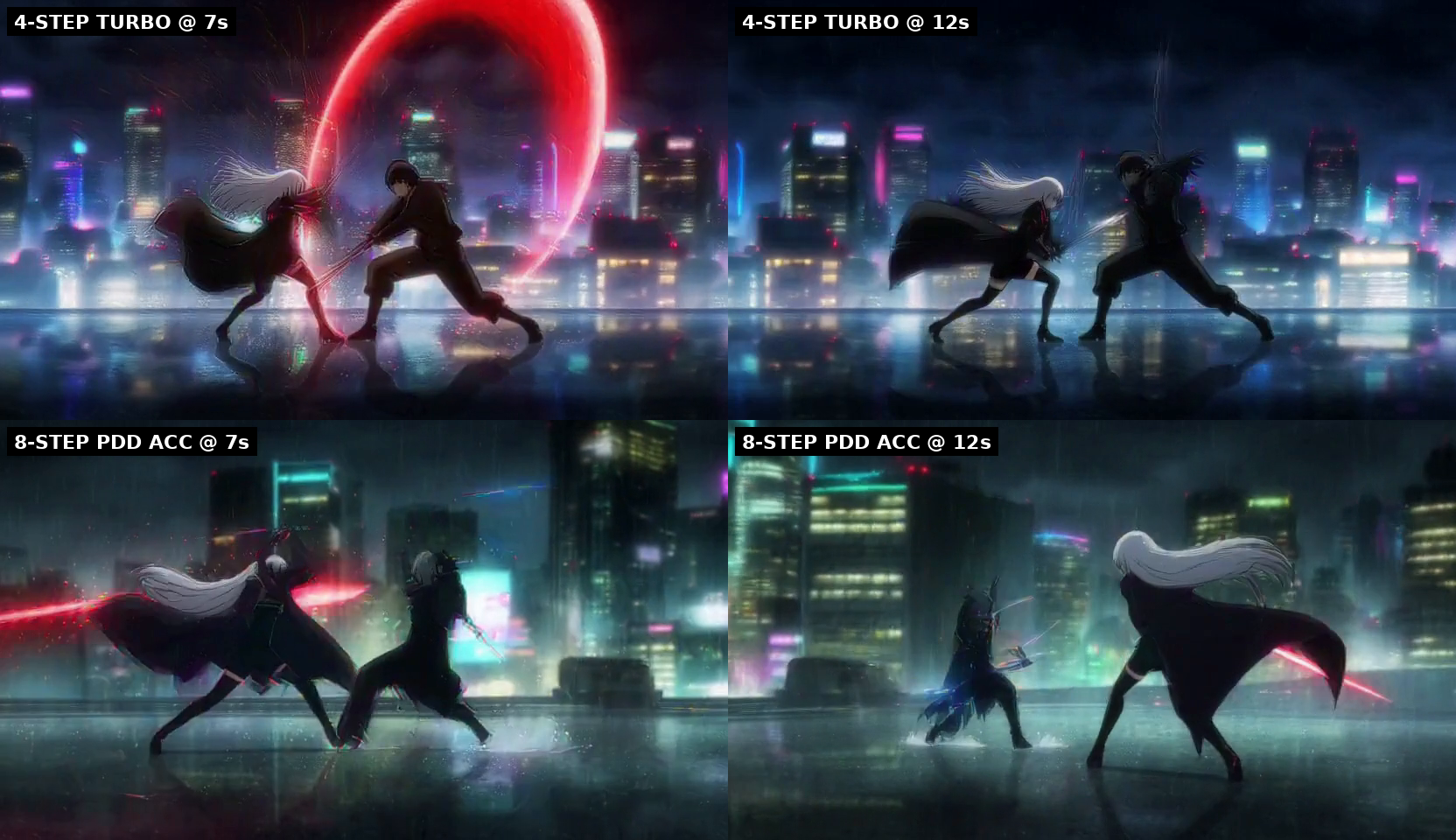
Top: 4-step turbo at second 7 and at second 12 of the same clip — the clash pose barely changes between the two moments. Bottom: 8-step PDD Acc at the same two moments — the characters have spatially separated, the action moved forward.
Across 5 seconds of clip, the 4-step version essentially keeps the same clash composition frozen — the red energy arc is still there, the distance between the characters barely changes. The 8-step version, over the same interval, shows real progression: spatial separation, motion continuity, the choreography advances. It’s not that the 4-step turbo produces ugly frames — it’s that it seems to “get stuck” on a pose instead of developing the action over time.
Confirmation with a second scene
Different fight scene, 5.17s, same prompt and seed across all three variants: 4-step turbo, 8-step PDD Acc, and the two-sampler hybrid trick.
With a completely different prompt and scene (a fight with clear foley instead of the sword duel), the pattern repeats: the mid-clip frame of the 4-step version shows a blurry, hard-to-read clinch, while PDD Acc and the hybrid both show a sharp, legible fighting stance at the same moment. Two scenes, two prompts, same pattern — not a coincidence from a single test.
Real installation: none of this is where you’d expect
Three things no regular LoRA tutorial prepares you for:
- The folder isn’t
models/loras/. It’sComfyUI/models/pdd_acc/, and it probably doesn’t exist yet in your install — you’ll need to create it by hand with that exact name. - There are two files, not one.
MiniMax-H3-FL2VA-Acc-8Step.safetensorsandMiniMax-H3-Ref2VA-Acc-8Step.safetensors(1.37GB each). Using the one that doesn’t match your base checkpoint throws no error — the result just comes out wrong and looks like the LoRA is broken. - The custom node didn’t register until a full restart. We cloned
Jalen-Brunson/ComfyUI-MiniMax-H3-PDD-Accwith no errors, but theMiniMaxH3PDDAccApplynode wasn’t showing up as available. The cause: an earlier ComfyUI process had stayed alive, still listening on the same port after a normalkill— it tookkill -9and a clean relaunch for the node to actually register.
The node’s own README also demands a stricter sampler recipe than regular turbo: euler as the sampler, full stop (no er_sde, no dpmpp), sigmas have to come from the MiniMaxH3PDDAccApply node itself (not a generic BasicScheduler), the 1.0 CFG gets applied via BasicGuider instead of the KSampler’s cfg field, and it explicitly warns against stacking this LoRA with regular turbo LoRAs — they’re two different distillations that don’t combine well.
The hybrid trick: almost as good, but the timing number has a catch
The original video proposed chaining two samplers to save time without losing action quality: a first pass with the 8-step PDD Acc LoRA (drives the motion), then a second pass with the 4-step turbo at low denoise, just to refine detail. It didn’t give an exact denoise value — we used 0.3, our own call, not the original video’s.
Visually, the result is almost indistinguishable from pure PDD Acc — makes sense, it’s a light refinement pass on the same already-resolved action latent. But the timing figure (83.5s vs. pure PDD Acc’s 120.3s) needs a real caveat: our ComfyUI log shows “0 models unloaded” for that run, meaning it benefited from the model cache still warm from the PDD Acc run that ran immediately before it. This isn’t a clean cold comparison — we can’t confirm the savings would be as large starting from a freshly launched ComfyUI.
Time and VRAM: in our tests, 8-step consistently takes longer
| Scene | 4-step turbo | PDD Acc 8-step | Difference |
|---|---|---|---|
| Sword duel (360 frames) | 229.5s | 366.4s | +60% |
| Fight (124 frames) | 79.9s | 120.3s | +51% |
The pattern repeats across two scenes of different length and content, on the same hardware and resolution (832×480): the 8-step LoRA takes between 51% and 60% longer than the 4-step turbo. Not a fluke from a single test. Real VRAM peak: 23.27GB with pure PDD Acc, 23.53GB with the hybrid — both leave little headroom on a 24GB card. We didn’t capture the 4-step baseline’s VRAM peak in the fight scene (the logger started late), so we can’t give a comparable VRAM figure for that variant.
Limitations of this test
- We couldn’t verify the original video’s claim about audio (that it sounds “unrealistic” with 4 steps) — we didn’t run a controlled listening evaluation.
- The hybrid trick’s timing was measured with a warm model cache, not cold — the real savings starting from a freshly launched ComfyUI could be smaller.
- The denoise value (0.3) for the hybrid’s second pass is ours, not the original video’s, which didn’t give an exact number.
- We only tested the hybrid trick on the fight scene, not on the sword duel — we don’t know if the “almost as good as pure PDD Acc” pattern holds on a clip three times longer.
- A single GPU (RTX 3090), no statistical repetition within each individual test — we did repeat across two different scenes and prompts, which is what gives us confidence in the pattern.
- We didn’t capture the 4-step baseline’s VRAM peak in the fight scene (an instrumentation miss, not a model issue).
Conclusion
Alibaba PAI isn’t overselling this entirely, but it’s not the simple “4-step is bad” story either. Across two different scenes and prompts, both LoRAs produce individually attractive frames — the real difference is whether the choreography advances over time or gets stuck on a pose. The 4-step turbo seems to freeze the action; the 8-step PDD Acc develops it, at the cost of 51-60% more generation time, consistently across both tests.
🏆 Our recommendation
If your scene depends on action progressing legibly over time (fights, complex movement, choreography), use the 8-step PDD Acc and accept the time cost. If your scene is more static or motion matters less than iteration speed, the 4-step turbo remains a reasonable choice — it doesn’t produce ugly frames, just less dynamic choreography. The hybrid trick is worth trying if you need that middle ground, but don’t trust the time savings we saw without measuring it yourself, cold. And before installing the LoRA, create the models/pdd_acc/ folder by hand and make sure you download the right file for your checkpoint (FL2VA or Ref2VA) — the wrong one gives no warning, just a worse result.
Keep Reading
If you haven’t tried MiniMax H3 on your RTX 3090 yet, start with our Sage Attention and Sol-Attn test. If you’re after swapping identities in video with this same model, we tested real face swap with Ref2VA, including the same kind of LoRA substitution we document here. And if you need videos longer than a few seconds, we tested Motion Director for chaining segments with continuity.
Next steps in ComfyUI
Getting started
More video and image AI workflows
- Wan 2.2 in ComfyUI: image-to-video Dual-model MoE architecture, VRAM requirements and real output.
- HunyuanVideo 1.5 in ComfyUI Real install of the I2V 480p step-distilled variant on an RTX 3090.
- 5 local AI video models tested on one RTX 3090 LTXV-2.3, SCAIL-2, Wan 2.1 and Wan 2.2, all benchmarked on the same hardware.
FAQ
- What exactly is the PDD Acc LoRA, and how is it different from the turbo LoRA we already used?
- It's an official acceleration LoRA released by Alibaba PAI (`alibaba-pai/MiniMax-H3-Acc-LoRAs`, ~210 likes on HuggingFace) that gets generation down to 8 steps using a parallel-decoding head bank over the model's own trained sigmas, instead of the distillation approach behind lightx2v's 4-step turbo LoRA we used in earlier articles. They're not interchangeable or comparable as "same technique, different step count" -- they're two distinct acceleration mechanisms.
- Where does the PDD Acc LoRA file actually go?
- NOT in `models/loras/`, where any normal LoRA would go. It goes in its own folder, `ComfyUI/models/pdd_acc/`, which you'll likely need to create by hand. There are also two separate files depending on your base checkpoint -- one for FL2VA, one for Ref2VA -- using the wrong one throws no error at all, it just produces a bad result that looks like "the LoRA is broken".
- Is the two-sampler hybrid trick (8-step + 4-step) worth it?
- Visually, the result is almost indistinguishable from pure 8-step -- makes sense, it's a low-denoise refinement pass on the same already-resolved action latent. But read the timing number carefully: in our test, the hybrid benefited from a model cache already warmed up by the PDD Acc run that ran right before it ("0 models unloaded" in the log) -- it's not a clean cold comparison against pure 8-step. We can't confirm the time savings would be as large starting from a cold ComfyUI.
- Did you confirm what the original video said about audio?
- We couldn't. The video claims audio sounds "unrealistic" with the 4-step LoRA in fast motion, and better with the 8-step one. All three clips we generated do have an audio track with no errors, but judging whether one "sounds worse" than another requires a human ear -- it's not something we can objectively verify ourselves. We're leaving it as an open question, neither confirmed nor ruled out.
- Why did the output frame count match exactly what was requested this time?
- In our earlier article on MiniMax H3 face swap, we had to substitute a LoRA that didn't publicly exist under the exact name the original workflow asked for, and we suspected that substitution was causing an unrequested frame-count cut. Here we used the official LoRAs exactly as Alibaba PAI and lightx2v publish them, with no substitution -- and in both tests (360 and 124 frames requested) the output matched exactly. It's one more data point in favor of that earlier article's hypothesis, not definitive proof.
- What real installation snag did you hit that no tutorial covers?
- The custom node didn't register in ComfyUI until we fully restarted the server from scratch -- a normal `kill` on the previous process wasn't enough because an earlier process stayed alive, still listening on the same port. Until we did `kill -9` and relaunched clean, the `MiniMaxH3PDDAccApply` node didn't show up in the available node list, even though the `git clone` had completed with no errors.
- Is the sampler recipe the same as with the 4-step turbo LoRA?
- No, it's stricter. The node's own README requires `euler` as the sampler, full stop (no `er_sde`, no `dpmpp`), the sigmas must come from the `MiniMaxH3PDDAccApply` node itself (not a generic `BasicScheduler`), the 1.0 CFG gets applied via `BasicGuider` instead of the `KSampler`'s normal `cfg` field, and it explicitly warns against stacking this LoRA with regular turbo LoRAs -- they're two different distillations that don't combine well.